Independent operators
What a national group has over you is not talent. It is staff.
Your crews are as good. Your ground is the same. The difference is that they can afford people whose whole job is to notice things, and you are doing that yourself at nine at night after the trucks are back.
The difference is overhead, not ability.
A group with 90 branches employs a dispatcher who does nothing but sequence routes, an analyst who costs jobs every week, a collections clerk who works the aging every morning, and an estimator with a decade of data behind them. None of those jobs produce revenue. They exist because the group can spread them across enough branches to be worth having.
You have the same problems and one person to solve them, and that person also answers the phone when a customer is unhappy about a gate left open. So the routing does not get looked at, the job costs get reviewed in the spring, and the renewal that was drifting in November is a cancellation in March.
So hire the work, not the people.
Nobody is being replaced. The work those roles do is mostly reading, comparing and chasing, and that is exactly the part a machine is good at.
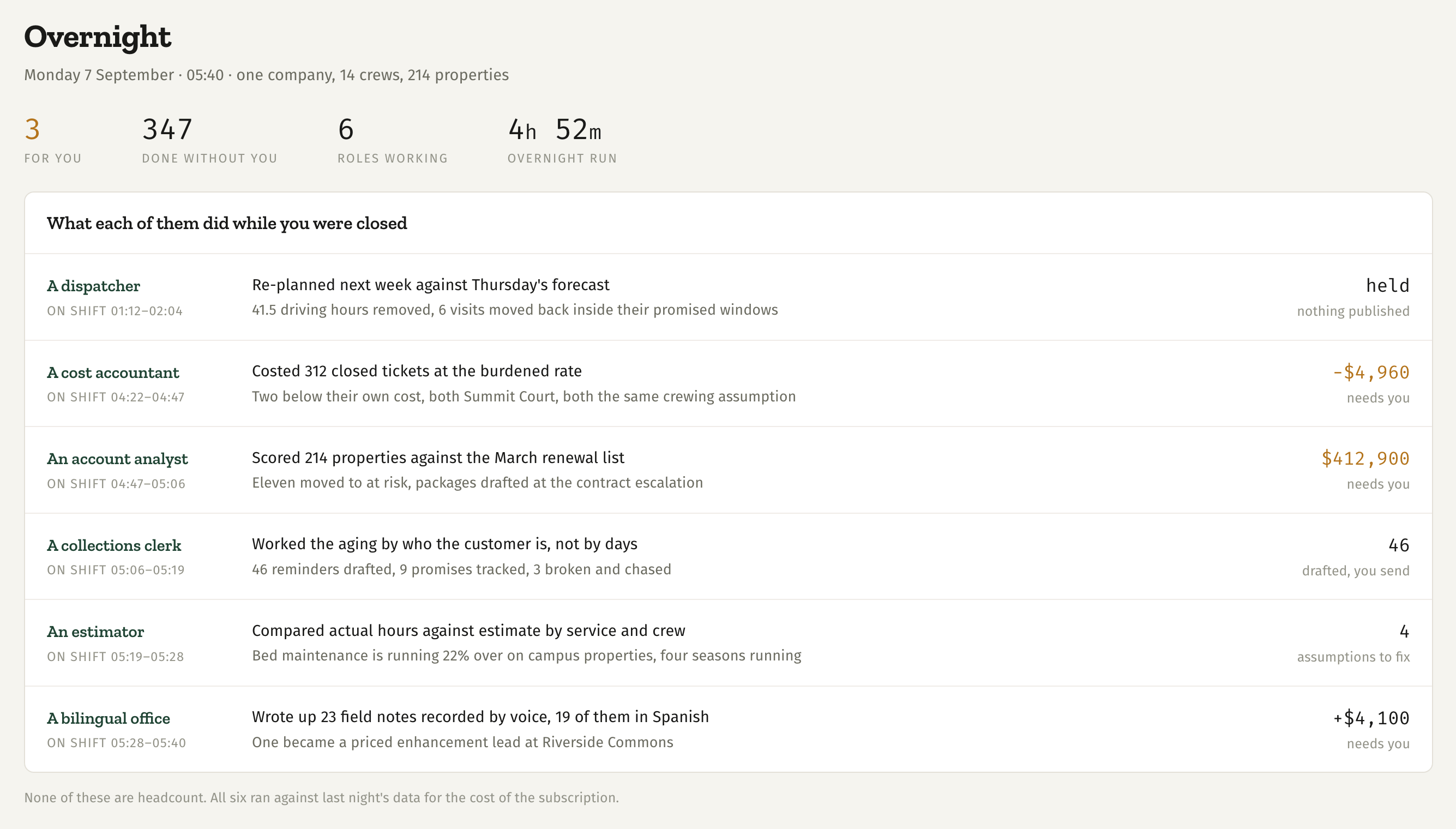
So the dispatcher, the analyst, the collections clerk and the estimator become six things that happen overnight and hand you one short list in the morning. You still make every call. You just stop being the only person standing between your records and somebody noticing what is in them.
That is the whole pitch, and this is the first time it has been true at your size.
Six roles you could never justify as headcount
Working your data every night, and reporting to you in the morning.
Next week sequenced every night against drive time, crew continuity, access windows and the visit counts in your contracts. When Thursday rains, a new week is proposed in minutes instead of over a phone tree.
Nothing publishes to the field until you say so.
Every ticket costed as it closes, at the fully burdened rate, with materials, equipment and subs included. What a job actually cost to deliver is something no platform in this category works out, which is why work sold below cost stays invisible until the season is over.
You find out in June, not in January of the following year.
Every property scored on service history, complaints, margin, visit coverage and the increase you are about to ask for. The at-risk list arrives 90 days before renewal with the outreach already drafted.
Retention is the biggest number in most of these, and the one nobody has time to work.
The aging worked by who the customer is and how they pay, rather than by days outstanding. A light nudge for a good payer at 35 days, a call script for the commercial account at 90 with three open disputes. Promises tracked and followed up when broken.
Drafted daily. You send.
Actual hours compared against the estimate by service, property type and crew, so the assumptions that keep being wrong get corrected before they are priced into next season.
A request becomes a priced proposal in hours rather than days.
Field notes captured by voice in the language the crew actually speaks, confirmed back to them in that language, and filed in your records in English. Safety material reaches people in a language they understand, which is the law rather than a courtesy.
Translation stops depending on whichever crew leader is bilingual.
Why this is affordable at your size now, and was not before.
Serious operations software has always carried a setup cost of one and a half to three times the first year's license, and multiples of that over the life of the system as the change orders pile up. That is the real reason this kind of software has only ever been sold to companies big enough to absorb a six-figure project.
The cost of tailoring software to one company has collapsed. That does not make us generous. It makes a market that was never reachable suddenly reachable. You are the reason we think this is a business.
Run the consolidator's playbook on yourself.
The groups buying companies in your market are not doing anything mysterious. They improve retention, they find the work delivered below cost, they capture the labor that never reached a ticket, and they apply the escalations that were being forgotten. Then they sell the improved number.
You can pull those same levers without selling anything. And if you do decide to sell, you walk into diligence already knowing what a buyer will find, because you found it first and fixed most of it.
Every finding in that register came out of software the company already owned. None of it required a bigger business, only somebody with time to look.
Start where you already are
You are running something today, and you should keep running it. Trellis connects to it, reads a season of your history, and comes back with a register sized against your own numbers and checked against your financials. That takes four weeks and changes nothing in your system.
If the numbers justify it, we turn on one agent against the biggest thing we can prove, and you approve every action it takes. Canopy is there if replacing your system ever becomes worth it, and plenty of operators never get there.