Product
Canopy
Everything from the customer record to the invoice, in one system: estimating, scheduling, crew time, purchasing, job costing and collections. Built so the work gets done overnight instead of waiting for somebody to get to it.
Everything your current system does. Then the part it never did.
The first question every operator asks is whether they would lose anything by moving. You would not. Canopy runs the whole operating week, and the agents are on top of it rather than instead of it.
- Customers, properties, contracts and service catalog
- Estimating and proposals, with aerial measurement
- Scheduling, routing and dispatch
- Crew time, equipment and materials
- Purchasing, receiving and subcontractors
- Job costing at the burdened rate, as each ticket closes
- Invoicing, receivables and collections
- Renewals, escalations and at-risk scoring
- Snow, irrigation and seasonal programs
- Journal entries out to QuickBooks, Sage Intacct or NetSuite
Delivered margin per job is the one on that list no platform in this category actually computes, which is why work sold below its own cost tends to stay invisible until the season is over.
Building next week
The most valuable thing in the product, and the part that is not a chatbot.
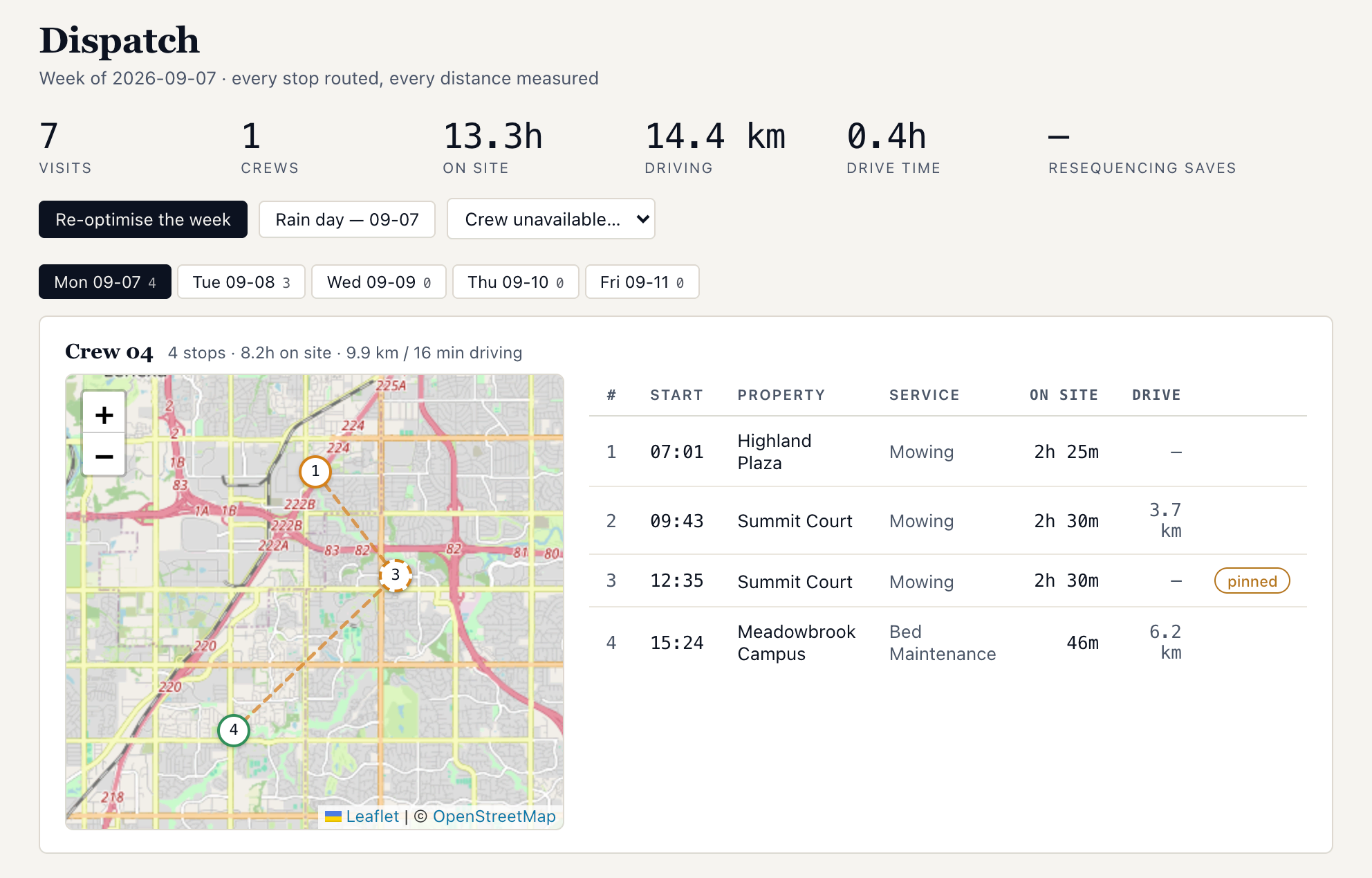
You say it the way you would say it to your dispatcher. Get the Riverside crew off the north side next week, Marcus is out Thursday. The week gets worked out against every rule you operate under, and comes back with the tradeoffs shown.
This part is arithmetic, not a language model having a guess. Ask a chatbot to build next week and you get something that reads well and puts a crew somewhere it is not licensed to be.
When it cannot be done, you do not get an error. You get which four properties have to move and what that costs you in drive time and overtime. Nothing reaches a crew until you publish it, and anything you decided by hand stays decided when Thursday's forecast forces a rebuild.
Rules it will not break
- Frequency windows that ratchet, so a 7-day mow runs 5 to 10 days after the last visit
- What a crew can actually finish in a day, after drive and load time
- Who is allowed to do what: licensed applicator, the right license for the trailer, the right equipment for the slope
- Access windows, so school grounds get done after 15:30 and restaurant lots before 10:00
- Language, so a Spanish-only site contact gets a crew leader who speaks it
- Visits per season promised in the agreement
What it is trying to get right
- Drive time between stops, from real road data rather than straight lines
- Keeping the same crew on the same property, which drives complaints more than anything else
- Overtime, by crew and by state rules
- Leaving slack in the week, so there is somewhere to put the rain days
Your crews will actually use it.Apps coming soon
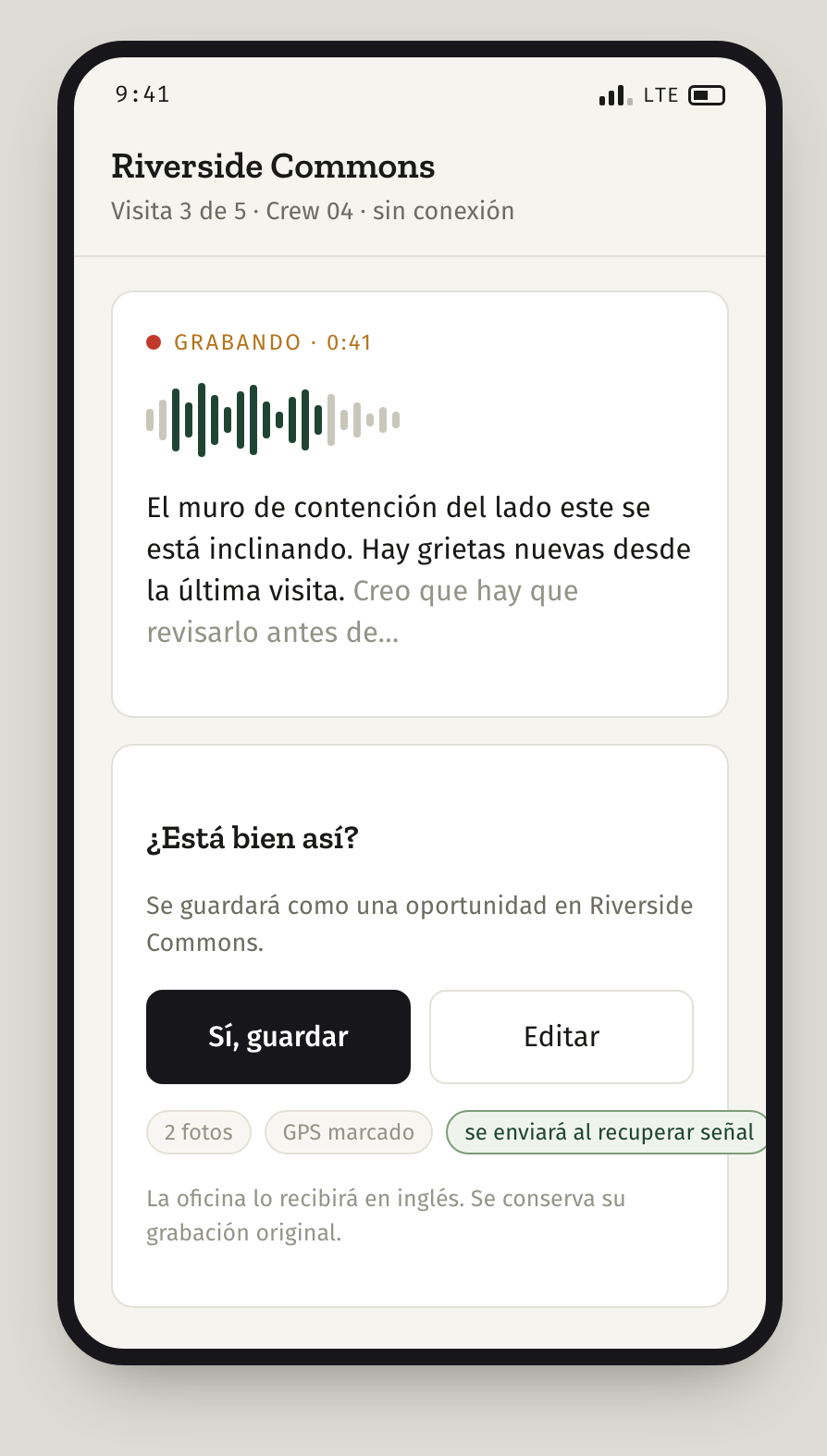
A crew leader records the visit, flags the broken irrigation head, photographs the supplier ticket and asks what was done here last year — standing in a parking lot, with gloves on, in Spanish, on one bar of signal.
If that does not work, none of the rest of it works either, because the record never gets made in the first place.
It speaks their language, not just yours
Most commercial landscape companies have a mostly Spanish-speaking field workforce, a bilingual crew-leader layer and an English-speaking office. Depending on the market, add Haitian Creole, Portuguese, Nepali or Ukrainian. Safety information has to reach a worker in a language they actually understand, which is the law, not a courtesy.
Everything else in this category treats the office language as the only one, so translation lands on whichever crew leader happens to be bilingual. Notes come back thin and sign-offs get signed without being understood.
Canopy keeps what was actually said, shows each person their own language, and files it in English for your records. The original recording is kept as evidence, which matters the day a customer disputes what a crew reported.
It works where the work happens
- Push to talk in a truck cab with a mower running, confirm with one tap
- Offline all day, syncing when signal comes back
- Photographs attached to the ticket, not to somebody's camera roll
- Runs in the phone browser today, with no app store to get through
Native iPhone and Android apps are in build and will land before general availability. They add push notifications, faster capture and background drive-time data. If field capture is the main reason you are looking at this, say so early and we will sequence your rollout around those dates.
Everybody gets at it their own way
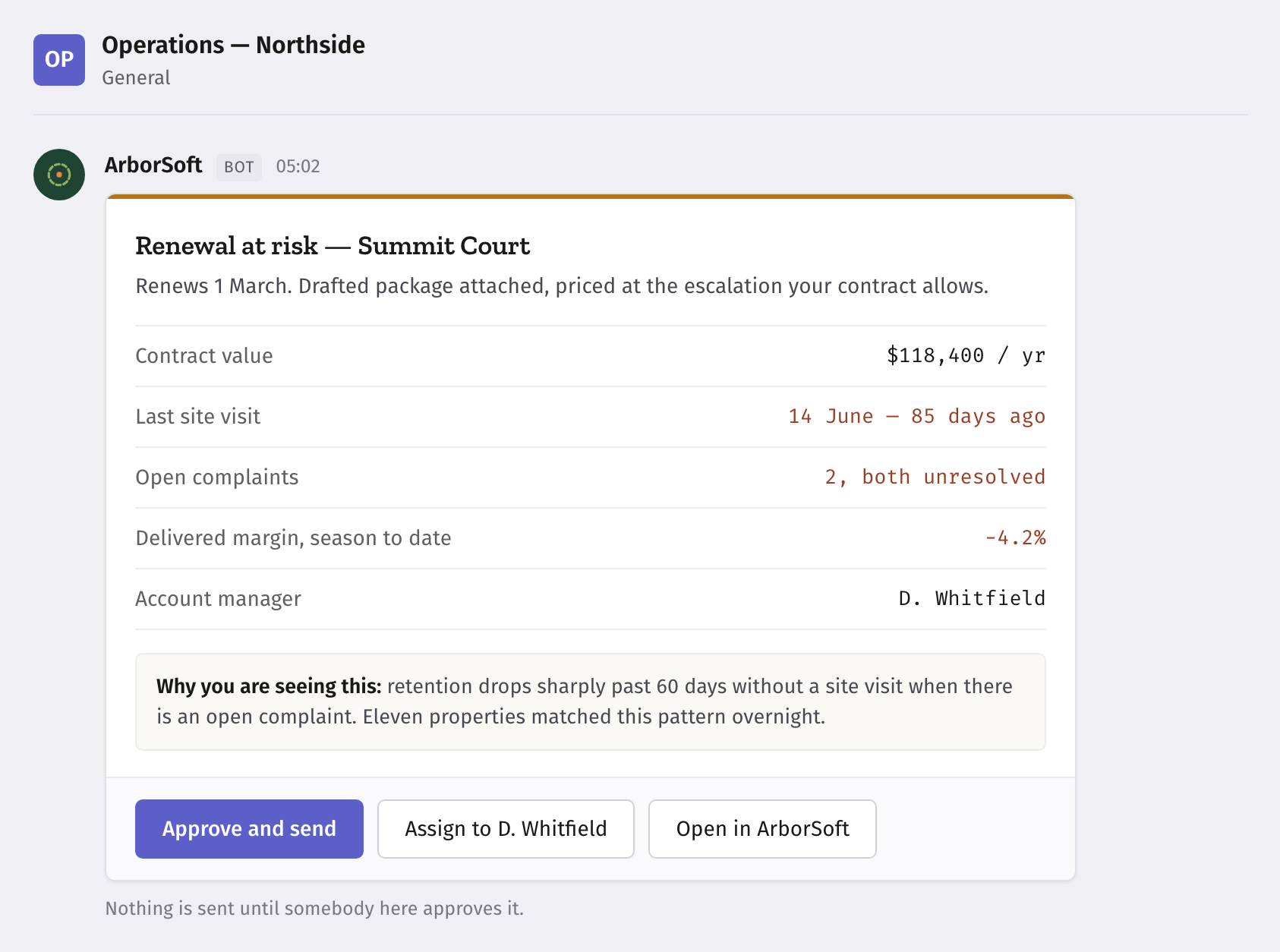
A crew leader asking by voice, an account manager asking in Teams and an owner asking from their phone all reach the same system, and each one sees only what they are allowed to see.
Anything you can do by clicking you can also do by asking. Turn the asking off entirely and everything still works by hand.
Next week, as something you can argue with. Ask for a change in plain words and see what moves against the version your crews have already seen.
Publish when you are happy with it.
Every ticket note, photo, issue, dispute and weather event on one timeline.
Ask what the story is with a property and get an answer that shows its receipts.
Aerial measurement produces the quantities and your catalog prices them, while the estimator sees how the price compares to what actually wins on this kind of property.
A request becomes a priced proposal in hours.
Whatever billing, collections, receipt matching and payroll could not settle on their own.
Each item shows what would change and what it is worth.
Voice first and offline always, in the language the person actually speaks.
Works in the phone browser today.
The Monday scorecard, an at-risk renewal nudge, an approval card for a credit memo.
It comes to you rather than waiting to be opened.
If your office already uses Claude or ChatGPT, it can pull from Canopy directly.
Under that person's login, and only what they are allowed to see.
What Canopy does not do
Being straight about the edges is most of the reason a product like this ever ships.
Not a payroll processor
We work out hours, allocations, pay codes and overtime exposure, then hand a file to your payroll provider. Tax filing is somebody else's regulated problem.
Not a general ledger
We own receivables, job cost and earned revenue, and post summarized entries to QuickBooks, Sage Intacct or NetSuite.
Not a telematics vendor
We read your existing GPS and vehicle feeds to close the loop on drive time. We do not build hardware.
Not a design tool
Measurement reads aerial imagery and site plans and produces quantities. Landscape architects keep their own software.
Not a chatbot with a database behind it
Turn the talking off and everything still works. That is the test we hold ourselves to.
Never a number you cannot check
Any figure it produces links back to the tickets, contracts and time entries it came from. Your controller can check it without calling us.
Canopy can be a subscription we host, or you can license it and run it in your own cloud with us managing it. Both options are here.
Canopy and Trellis run the same agents.
The only difference is where your records live. Under Canopy they are here, which is what lets the whole thing be built for this in the first place. Under Trellis they stay exactly where they are and the agents reach them through the system you already run.
Plenty of operators start with Trellis, prove the numbers on their own data, and move to Canopy later. Some never move, and that is a fine outcome.