Groups and rollups
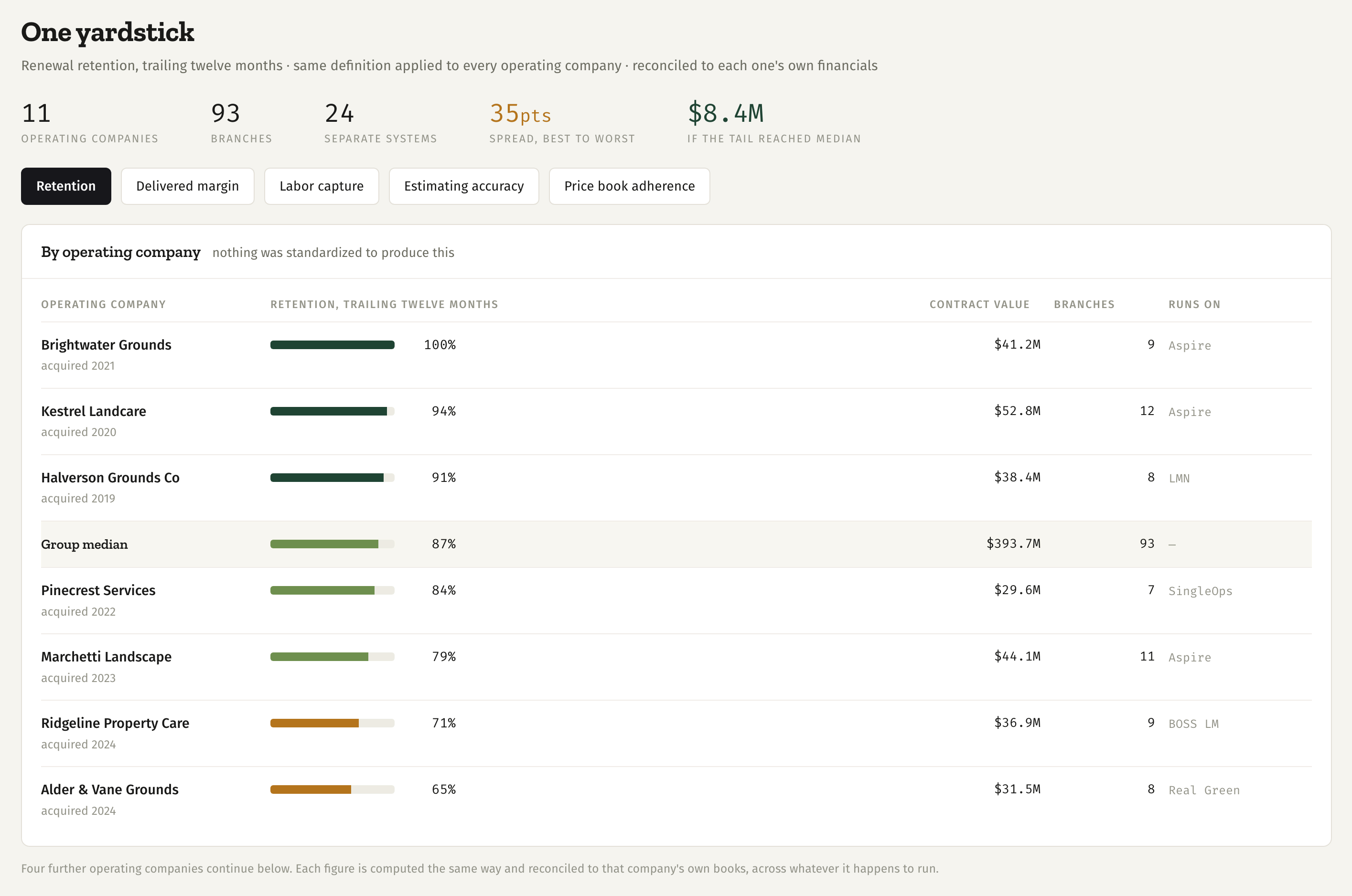
You bought eleven companies. You inherited two dozen systems.
Every acquisition arrives with its own system, its own price book and its own idea of what a billable hour is. Getting one set of numbers out of that is faster with AI than with another two-year standardization program.
One system for everyone is a three-year answer to a this-quarter question.
The usual plan is to move every company onto one system, one chart of accounts and one service catalog. It is the right long-term answer and it is genuinely hard. It competes with the deal pipeline for the same few people, it puts a season of production at risk every time, and you only get comparable numbers when the last company lands.In the meantime nobody can answer the questions the board is asking. Which branches actually retain customers. Which brand prices work correctly. Whether the margin in the model survived the first full season under your ownership.
The agents do not need your systems to match.
They only need to be able to read them. The same definition of a clocked hour, the same margin calculation and the same renewal outcome get applied on top of whatever each company happens to run, without touching any of it. That gives you comparable numbers in weeks instead of at the end of a migration, and it does not tie up the people who are supposed to be integrating the next deal. If you still want one platform in three years, nothing here works against that.What changes at group level
Retention, delivered margin, labor capture rate and estimating accuracy computed the same way in every operating company, reconciled to each one's own financials.
Branch-to-branch comparison that survives an argument with the operating company president.
Score a target's operating data before close: real margin by service line, retention by branch, how much of its labor reaches a ticket, and how much of its price book is fiction.
The operating story behind an adjusted EBITDA number, from the target's own system.
Visibility in the first month instead of the first year.
Limits are set per operating company. A business acquired last month watches. One that has been on the platform two seasons acts inside its own limits.
You do not have to trust the whole portfolio to the same degree at the same time.
You can license the platform and run it in your own cloud rather than subscribing to it, with us providing upgrades, agent evaluation and capability development around it.
Technology becomes an owned asset in the portfolio rather than a vendor relationship a buyer will ask questions about.
An agent built for one operating company is available to all of them. An estimating assumption corrected in one becomes a question asked of the others. Nothing crosses brands automatically, but the group stops discovering the same thing eleven times.
The eleventh company onboards faster than the first, and the catalog is an asset the platform owns rather than a bill that leaves with the vendor.
The local brand is the asset. It should stay one.
Customers signed with the local name, and in most markets that name is the reason retention held through the sale. Nothing about running the group on agents should show up on an invoice.
Every customer-facing artifact keeps the local identity: the proposal, the invoice, the renewal letter, the email a client service manager sends. The group sees one set of numbers. The customer sees the company they hired.
Practical details
- Reads across as many systems as you have, including different ones
- Reports at group, operating company, brand and branch level
- Per-brand templates, sender identities and document branding
- People see only their own company, unless you say otherwise
- One operating company's data is never visible to another
The register on the evidence page came from exactly this shape of business: eleven operating companies, 93 branches, 24 separate systems. Nothing in it required the group to standardize first.
The group had every number in this register already. It was spread across eight systems that did not agree on what an hour was.
We have run multi-entity portfolios ourselves, and we have built the infrastructure that holds them together. The problems of a rollup are not really software problems. They are questions about which local practice was worth keeping and which one was just habit, and you cannot answer those without comparable data.